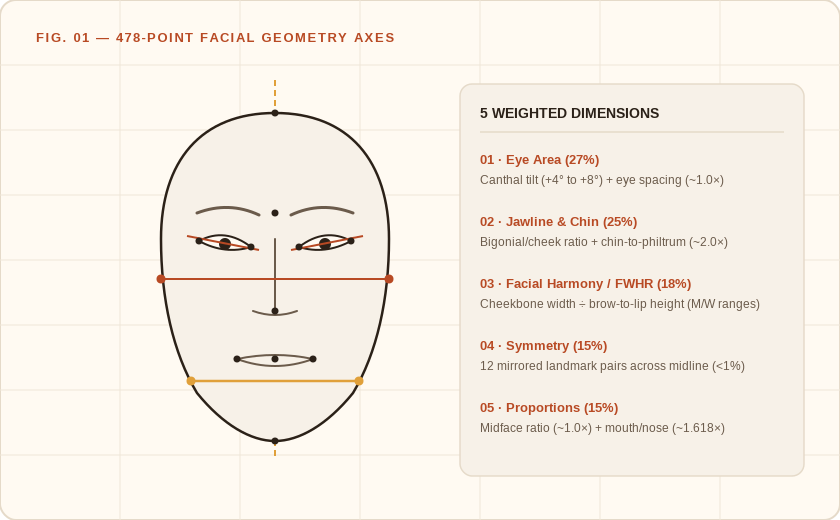
Overview: Deterministic Math Over Black-Box Guesses
Most online attractiveness raters hide how they arrive at a score. PSLScore takes the opposite approach: every reading returned on the PSL Score Test comes from MediaPipe FaceLandmarker running locally in your browser. Once 478 normalized (x, y) facial points are located, the scanner restores true aspect ratio (x × width / height), rotates coordinates so the line connecting the inner eye corners is horizontal (removing camera roll), and computes 11 unitless ratios and angles.
Because all 11 inputs are dimensionless ratios or angles, image resolution does not inflate or deflate your score — a sharp 800 px portrait and a 4000 px portrait of the same frame return the same geometry.
Step 1: The 11 Raw Landmark Measurements
| Measurement | How It Is Calculated | Ideal Reference Range |
|---|---|---|
| Symmetry offset | Mean mirrored distance across 12 left–right landmark pairs ÷ cheekbone width | 0.0% – 1.0% offset |
| Canthal tilt | Average angle (degrees) from inner eye corner to outer eye corner | +4.0° to +8.0° |
| Eye spacing | Intercanthal gap ÷ average eye width | 0.95× – 1.10× |
| Jaw-to-cheek ratio | Bigonial jaw width ÷ bizygomatic cheekbone width | Men 0.84–0.94× · Women 0.76–0.86× |
| Chin-to-philtrum ratio | Lip-to-chin height ÷ nose-base-to-lip height | 1.90× – 2.30× |
| Midface ratio | Brow-to-nose height ÷ nose-base-to-chin height | 0.95× – 1.08× |
| FWHR (Harmony) | Cheekbone width ÷ brow-to-upper-lip height | Men 1.85–2.10× · Women 1.70–1.95× |
| Mouth-to-nose ratio | Mouth corner width ÷ nose wing width | 1.50× – 1.70× (golden ratio ~1.618) |
| Length-to-width | Forehead-top-to-chin length ÷ cheekbone width | Used for face shape classification |
| Forehead ratio | Forehead width ÷ cheekbone width | Used for face shape classification |
| Head yaw | Horizontal offset of nose tip between cheekbones | Must stay ≤ 0.12 for fair readings |
Step 2: Band Scoring and Category Weights
Each raw measurement is graded on a 2.0–10.0 sub-score curve: values inside the reference range score 10.0, and values outside fall linearly toward a floor of 2.0 based on distance from the nearest bound. Those measurements combine into five weighted dimensions reflecting how facial-aesthetics communities weight structural features:
- Eye Area (27%) —
70%canthal tilt +30%inter-eye spacing. - Jawline & Chin (25%) —
65%jaw-to-cheekbone ratio (sex-specific) +35%chin-to-philtrum ratio. - Facial Harmony / FWHR (18%) —
100%facial width-to-height ratio (sex-specific). - Facial Symmetry (15%) —
100%12-pair mirrored midline symmetry across eyes, brows, nose wings, mouth corners, cheekbones, and jaw. - Facial Proportions (15%) —
50%midface vertical ratio +50%mouth-to-nose golden ratio proximity.
Step 3: Why Clearing 6.0 Requires Convex Mapping
After calculating the weighted raw average (raw, ranging from 2.0 to 10.0), PSLScore normalizes it to x = (raw - 2) / 8 and applies a convex curve:
PSL Score = clamp(0.5, 7.9, 8 × x^1.9)
That 1.9 exponent creates the strict compression that defines the 0–8 PSL scale chart:
- A balanced
7.5 / 10average across all five areas yieldsx = 0.6875, which maps to roughly3.9 / 8(Middle / MTN·MTB). - Scoring
5.0 / 8(Above average / HTN·HTB) requires averaging roughly8.2 / 10across all five categories. - Clearing
6.0 / 8(High / Chadlite·Stacylite) requires averaging nearly8.9 / 10, meaning almost no single dimension can lag far behind.
Step 4: How Face Shape Is Classified
Alongside the 0–8 score, three width-and-length ratios assign one of six face shapes used for haircut recommendations in your free report:
- Oblong:
lengthWidth > 1.55 - Heart:
foreheadRatio > 0.93andjawRatio < 0.78 - Diamond:
foreheadRatio < 0.85andjawRatio < 0.80 - Square: (
lengthWidth < 1.32andjawRatio > 0.86) orjawRatio > 0.90 - Round:
lengthWidth < 1.32andjawRatio ≤ 0.86 - Oval: Balanced proportions outside the extreme thresholds above.
Known Geometric Limitations
2D front-facing landmark geometry cannot measure side-profile forward growth (maxilla or chin projection), skin quality, hair density, or dynamic facial expressions. Always capture a clean eye-level portrait using our PSL photo guide so lens distortion does not skew your ratios.